What Couples Don’t Realize About Their Wedding Photos — Until It’s Too Late
Why Memory, Emotion, and Intention Matter More Than You Think
Most couples don’t worry about their wedding photos.
Not because they don’t care — but because they assume it’s handled.
They book a photographer they like. They trust the day will unfold. They believe the moments that matter will naturally be captured.
And for many, it’s only after the wedding — weeks, months, sometimes years later — that they realize something important was missing.
Not photos.
Memory.
The Psychological Trap of “We’ll Remember It Anyway”
There is a well-documented phenomenon in psychology known as memory reconstruction. Human memory is not a recording — it is a reconstruction, rebuilt each time we recall it.
Without emotional anchors, memories fade faster than we expect.
On a wedding day, couples experience:
- Heightened emotion
- Adrenaline and cortisol
- Sensory overload
- Constant transitions and decision-making
The brain prioritizes navigation and emotional regulation — not long-term memory storage.
This is why couples often say, “The day went by so fast.”
Photography becomes an external memory. But only when it captures more than what was staged.
Why Most Regret Isn’t About Missing a Photo
Couples rarely regret not having enough photos.
They regret not seeing their partner’s reaction. Not realizing how the room felt. Not knowing certain moments even happened.
These are not checklist moments.
They are emotional ones.
And emotional memory requires context — who was there, what happened before, how the moment unfolded.
When photography focuses only on posed or expected moments, that context disappears.
The images may be beautiful. But they do not carry weight.
The Wedding Day Is Not Linear — But Most Galleries Are
Weddings do not unfold neatly.
Emotion spikes and drops. Quiet moments interrupt loud ones. Some of the most meaningful interactions happen in corners, hallways, or seconds before something “important” begins.
Yet many galleries are structured around:
- Timelines
- Shot lists
- Aesthetic priorities
Instead of emotional flow.
Storytelling photography understands that memory is built through sequence, not highlights.
The breath before the moment matters as much as the moment itself.
A Real Wedding Day Moment
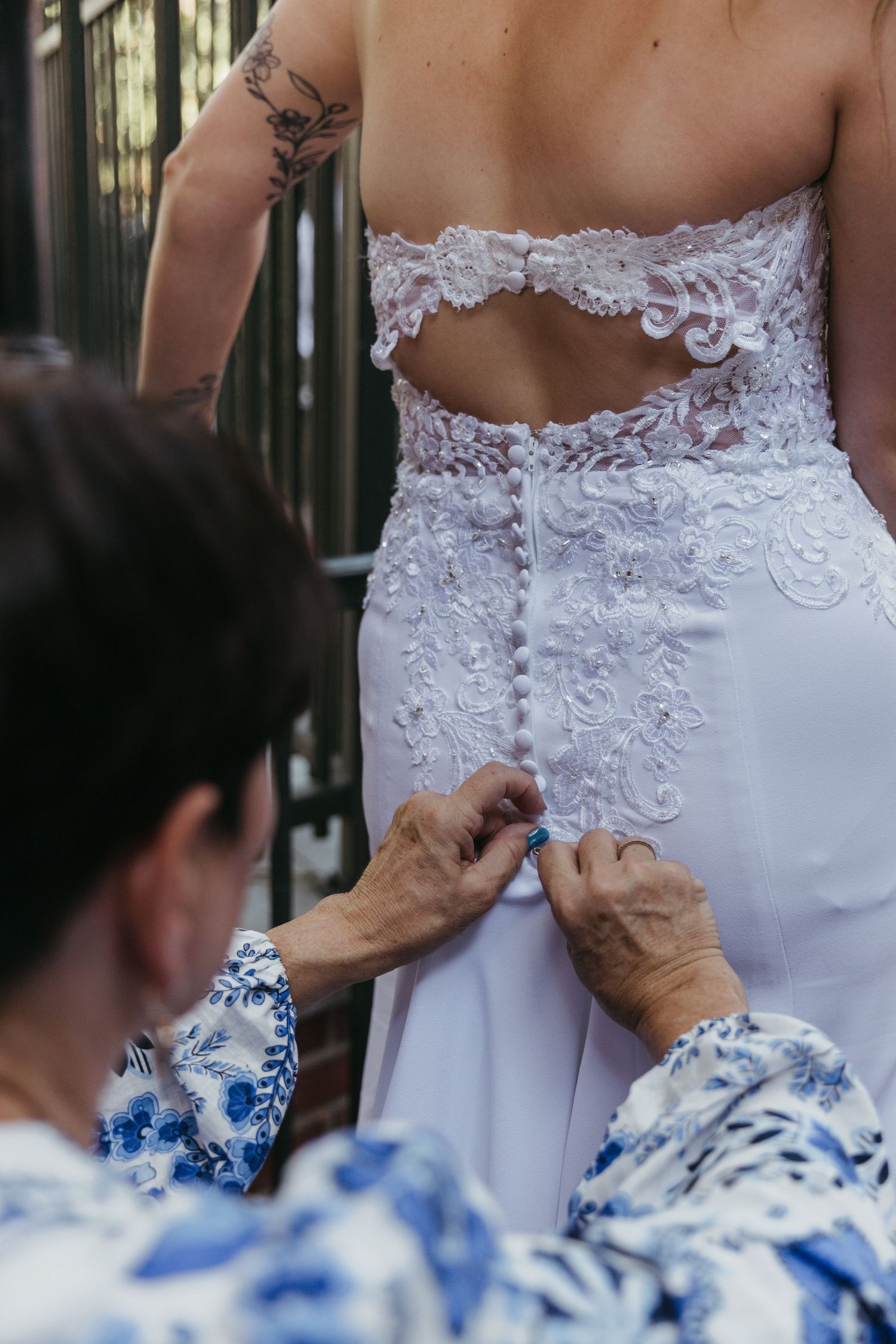
There was a moment at a wedding that never made the timeline.
The ceremony had just ended. Guests were standing, clapping, turning toward cocktail hour. The energy shifted quickly.
But off to the side, just outside the aisle, the bride stopped.
She closed her eyes and exhaled — deeply — as if releasing something she had been holding all day. Her partner reached for her hand without looking.
They stood there for six seconds.
No one noticed. Nothing “happened.”
Except everything.
Later, that image became the one they returned to most — not because it was dramatic, but because it felt true.
Why “We Can Recreate It” Is a Dangerous Assumption
Emotion does not repeat on command.
You can reposition people. You can reframe a scene. You cannot recreate nervous energy, relief, anticipation, or overwhelm.
Once those emotions pass, they are gone.
This is why couples sometimes feel disconnected from parts of their gallery — not because the photos are bad, but because the moments were already over by the time the camera arrived.
The Cost of Over-Management
Over-directing pulls people out of the moment.
Behavioral psychology shows that heightened self-awareness reduces emotional authenticity. When people feel observed, they perform instead of feel.
On a wedding day, this flattens emotion — especially in intimate moments.
Storytelling photography protects emotional integrity by knowing when to guide — and when to disappear.
Why Couples Realize This Too Late
On the wedding day, you trust the professionals. You assume the important moments are obvious. You focus on getting through the day.
It is only afterward, when the noise fades, that clarity arrives.
You realize certain moments mattered more than you noticed. Certain people meant more than you expected.
Photography becomes the bridge — or the gap.
What Actually Makes Wedding Photos Last
Longevity does not come from trends, poses, or perfection.
It comes from:
- Emotional accuracy
- Contextual awareness
- Restraint
- Anticipation
Photos last when they reflect truth — not performance.
When they remind you not just what your wedding looked like, but who you were in it.
This Isn’t About Fear. It’s About Intention.
This is not about regret. It is about awareness.
Your wedding day will move faster than you think. Memory is fragile, even when love is not.
Photography has the power to preserve what the mind cannot hold alone — but only when it is approached with intention.
Because the moments you don’t realize matter most are often the ones you miss first.